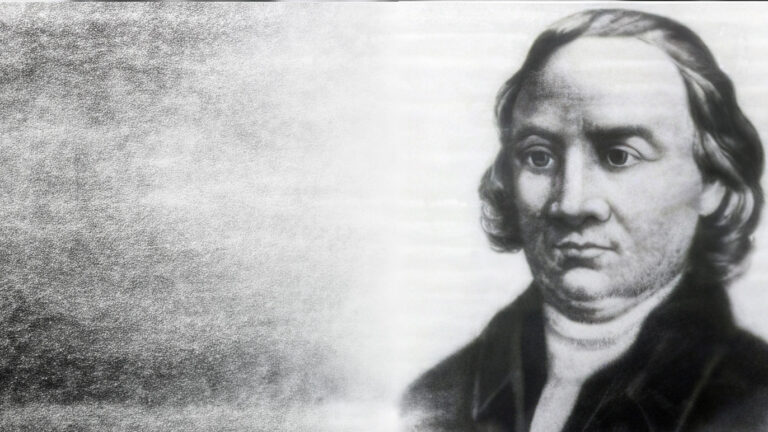
This article by Carl V. Lillvik – SFHS BOD Vice President – details the life of John Morton, a Founding Father of direct Finnish descent whose decisive vote in 1776 enabled the adoption of the U.S. Declaration of Independence. It traces his roots from Rautalampi, Finland, to his pivotal role in the Continental Congress and his contributions to the Articles of Confederation. The text also honors his legacy, his family’s service in the Revolutionary War, and his recognition at the Old Swedish Burial Ground in Chester, Pennsylvania.
John Morton (1725 – 1770) was a founding father with direct Finnish roots. Both sides of his family had Finnish heritage. His great-great grandfathe, Marti Martitsen (Martin Martinsen), immigrated from Rautalampi, Finland, in the 1650’s to the New Sweden colony (1638 – 1655) that is now Delaware County, Pennsylvania.
As a county representative to the Pennsylvania Assembly John Morton served in a variety of positions. In 1774, while serving as Speaker of the Pennsylvania Assembly, he was voted to be a delegate to the First Continental Congress held in Carpenter’s Hall in Philadelphia. On November 4, 1775, he was elected to the Second Continental Congress. The delegation of seven who were to cast Pennsylvania’s vote for the Declaration of Independence was divided. With two delegates absent, two voting nay and with two including Benjamin Franklin voting aye, it fell upon John Morton to cast the deciding swing vote for independence. He did so on July 2, 1776. It took until 4 July to get agreement on the edits for a printed copy for public distribution. On August 2, John Morton signed his name to the Declaration of Independence to eventually be one of fifty-six signers.
It is said that Pennsylvania, because of John Morton’s deciding vote, is nicknamed the “Keystone State”. For without Pennsylvania’s vote for independence the probability of it being adopted was doubtful. In 1776 and 1777, John Morton became Chairman of the Committee of the Whole and was heavily involved in writing the Articles of
Confederation, the new nation’s first form of government. Unfortunately, he did not live to see his efforts realized.
Morton was the first signer of the Declaration of Independence to die, April 1777. He was buried in Old St. Paul’s Church Burial Ground (also known as the Old Swedish Burial Ground) in Chester, Pennsylvania. Morton’s grave remained unmarked until October 1845, when the present-day 11-foot marble obelisk was erected by his descendants.
On July 5, 2004, in recognition of John Morton’s role in signing the Declaration of Independence, a plaque was placed at his gravesite by the Descendants of the Signers of the Declaration of Independence. He was the first of the fifty-six signers to receive this honor. Many of the descendants of John Morton were in attendance.
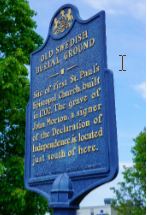
Chester, Pennsylvania
John Morton’s vote for independence from England helped to assure America’s future as a free and independent country.
John Morton with his wife, Anne, had nine children; three sons and six daughters. Their sons were Aaron, Sketchley and John. Sketchley served as a major in the Pennsylvania Militia of the Continental Army during the American Revolutionary War. Their third son, John became a surgeon and died while a prisoner of war on the British ship , Falmouth in New York Harbor. Their daughters were Sarah, Lydia, Elizabeth, Mary, and Anne. Anne, their youngest, married John Davis who was a Captain in the Pennsylvania Militia and also fought in the Revolutionary War.