Potatoes were served at nearly every dinner my mother or father prepared. Doesn’t everyone eat potatoes? Lots of them? My favorite is fresh boiled new potatoes dripping with butter and lightly seasoned with a dash of salt and pepper. Just off the plane where I explored Finland this summer, I am happy to report that the potato is still a favorite on the menu! Let’s take a look at the ever popular potato.
by Sinikka G. Garcia
I got all excited about finding a book titles “The Potato” on one of my typical visits to my favorite bookstore this summer. The Finns know about the potato and so do Finnish Americans. The potato kept us alive during Finland’s worst wars! Potatoes, rye bread, and six deciliters of milk per child per day kept us thin but alive. Potatoes were not rationed, yet not plentiful either until summertime when “family victory gardens” produced them.
So, when the word came that there were potatoes at the butcher’s, my brother and I were sent to stand In line. Sometimes the shops ran out of potatoes just when it was your turn or the potatoes were frostbitten and tasted unpleasantly sweet, but mostly we had boiled potatoes on the menu every day. And we never complained. In fact, even today I would choose potatoes over rice or noodles any day. Peeled, boiled potatoes in those days meant it was a holiday. Fried potatoes were made from yesterday’s leftover potatoes, and mashed potatoes were a real treat, as were scalloped potatoes baked with a ham bone. We kids learned to peel our own potatoes at an early age.
In fact, on my visits to Finland I enjoy watching 5-year-olds being masters at the art of potato peeling. (Hold it in your fork with your left hand, stab a starting point on the potato with a knife in your right hand and with steady strokes bring the peel toward you. Repeat the procedure as needed!) However, I remember hearing some wailing for assistance at times.
Some say the potato was called “earth pear” in Sweden, translated “Maa päärynä” but to us Finns, we have always called it PERUNA— the word that tells us where it came from: Peru! The potato’s history does start in Peru and is impressive because it covers the entire world history— the famines, the wars, the destruction, the plagues and recoveries. It grew wild and still does in the Andes in different shapes, sizes and colors. There were thousands of kinds of them!
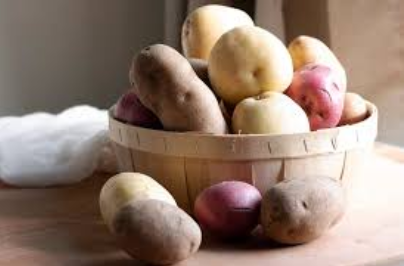
Then experts genetically reduced the number of types to 400 species, and today’s varieties are fewer than that. Today’s potato does not resemble the wild potato at all! It’s a sad story— the history of the potato. The Spaniards conquered Peru and the whole region in the 1500s, robbing their valuable gold and silver. Had the Andes people not been clever, they might have lost their potatoes as well. But they kept them in the ground where the enemy did not know to look. The wild potato could stand cold temperatures (as low as 27° F) up to a year in the high mountains.
For 300 years the Spaniards kept the people as slaves in the silver and mercury mines, where millions died of mercury poisoning. They also brought to the Andes all European diseases unknown to the region. It was the potato that kept the mines operating! Of course, some good came from the conquest; Spanish culture, language, teaching of governing methods, learning to use the llama as a beast of burden and trade developed and the potato was discovered by the whole world.
It is thought that the potato arrived In Europe in the 1600s through Spain’s Canary Islands with the cargoes of Peruvian treasures. And the potato became well known throughout Europe, reaching northern Europe almost 200 years later, it is thought of having arrived in Finland with the returning Finnish soldiers from Sweden’s 30-year wars. (As did tobacco and coffee.) Potato, “the magnificent tuber” (Solanum tuberosum tuberosum), is now grown in 149 countries and is the fourth most important food crop after wheat, maize, and rice. Although mostly water— 79 percent— ^the potato is “an exceptional all-round package of food that has nonfattening, slowly digestible carbohydrates, B-complex vitamins, calcium, iron, potassium,” among other benefits.
One can survive on potatoes alone! Such a simple common plant, the potato, has no impact on the environment, and is easily grown practically everywhere, yet it has its problems. It is a delicate plant! I know in Finland farmers were worried about dropping temperatures soon after planting time— hoping for the wind to blow the sinking frost away from their potato fields. The years 1868-69 were Finland’s Famine Years due to climactic crop failures. One third of the people died of starvation. A lot of Finns Immigrated to the United States after that. Potatoes are among the plants most vulnerable to disease. The cultivators of potatoes in this country and elsewhere need to be spraying their crops— up to 12 times a season to protect them.
A question comes to mind: how can the price of potatoes be so low when considering the expenses? For fun, I have grown potatoes in the flowerbed here in Arizona. One year my sixth-grade class grew potatoes in a metal bucket. We took the bucket out every morning, from February through April, to give the plants some sun, and we brought the bucket in before leaving school in the afternoon for there was still danger of freezing. We observed the changes daily— the growth and the blooming. We watered it faithfully. In April, the day the whole school was involved with the annual standardized testing, in complete silence by the sink, I harvested seven healthy potatoes. While the potatoes were bubbling in a pot on the hot plate, delicate aroma was spreading in the silent classroom. It was soon questioningly noticed! At recess we gathered around the mysterious pot and enjoyed our seven potatoes cut into many pieces and then with toothpicks the buttered pieces of our “magnificent tuber” were savored. The students couldn’t believe how tasty our harvest was!
In our backyard we have a potato tree! It has no resemblance to a potato plant except that it has purple flowers identical to the potato flowers. The potato tree Is actually a seven- to eight-foot shrub, and it is related to the potato family! It is a thirsty tree, not good for the desert, but because of its sentimental value and because it gives shade to the flowers underneath and is very pretty with all those purple flowers, we keep it! What a precious treasure is the Solanum tuberosum, the potato!
From The Finnish American Reporter, August 2009