4. Faith, Hope and Love
The day’s rhyming riddle was:
Faith, hope and love
The cross, anchor and heart are a familiar Christmas sight for many Swedish-speaking Finns. Together, they represent faith, hope and love, or tro, hopp och kärlek in Swedish. The illuminated symbols can be seen in windows and gardens, particularly along Finland’s Swedish-speaking Ostrobothnian coast.
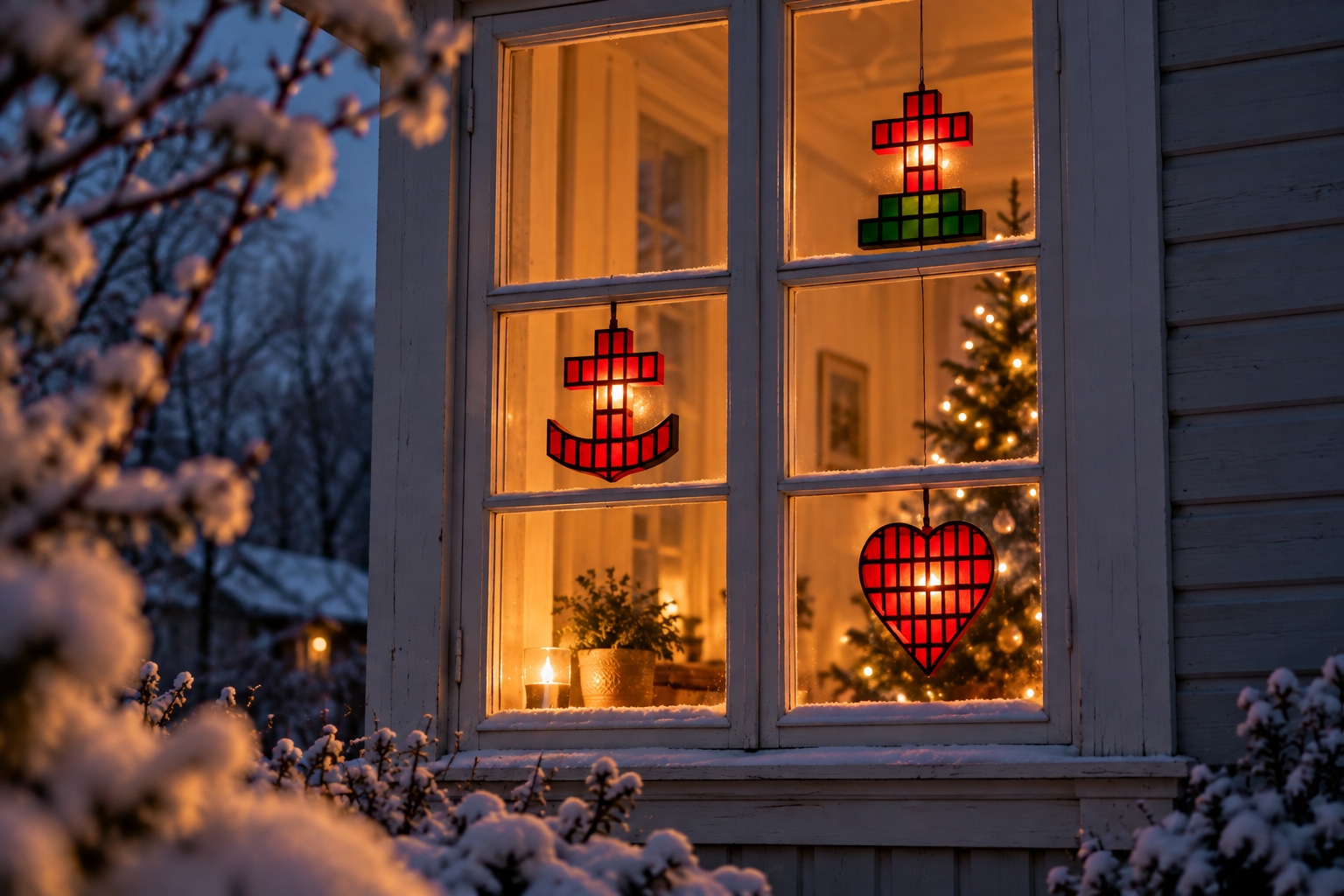
The tradition has particularly strong roots in Jakobstad, a coastal town with a long seafaring history. Its Christmas display of illuminated symbols can be traced back to the mid-19th century, when large lights were hung across Storgatan, the town’s main street. Interestingly, the original display consisted of a cross, an anchor and another cross. A heart was difficult to create around a burning candle, so it was not until 1913, with the arrival of electric lighting, that the familiar combination of a cross, anchor and heart appeared.
The symbols themselves have much older roots. Faith, hope and love are traditional Christian virtues, represented by the cross, anchor and heart, but the same imagery also became closely associated with seafaring culture. In a town where many men spent long periods away at sea, the symbols took on a particularly meaningful local character.
Their message is simple: the cross stands for faith, the anchor for hope and the heart for love. Traditionally, the symbols in Jakobstad were also placed in a particular order, with the cross representing faith positioned closest to the church.
From Ostrobothnia to the World
What began as a public Christmas display gradually found its way into people’s homes. In the early 1930s, smaller versions of the illuminated symbols began appearing in private windows, helping turn a local Jakobstad tradition into a familiar part of Christmas in the region.
Over time, faith, hope and love spread elsewhere in Swedish-speaking Finland and eventually far beyond the country’s borders.
For Swedish Finns living abroad, the three lights can carry a special meaning. More than a Christmas decoration, they can be a reminder of language, culture, family and the place their roots lead back to. A cross, an anchor and a heart can bring a little piece of a Swedish-Finnish Christmas into the home, even thousands of miles away.
Perhaps that is why their message has endured from one generation to the next: faith for today, hope for tomorrow and love to carry us through both.