
Ostrobothnian
Vörå
Land & Livelihood
Agriculture was a major part of the economy in Vörå. Torbjorn Nikus, one of our members of the Swedish Finn Historical Society from Vörå, called Vörå the ‘land of rye’. He described farming there and provided most of the information presented in the ‘Of Interest’ section.
Farming was a horse and human powered operation in the old days. Farm fields were bordered by fences made of thin spruce poles placed tight together such that animals could not walk through them. The land was intensively farmed.
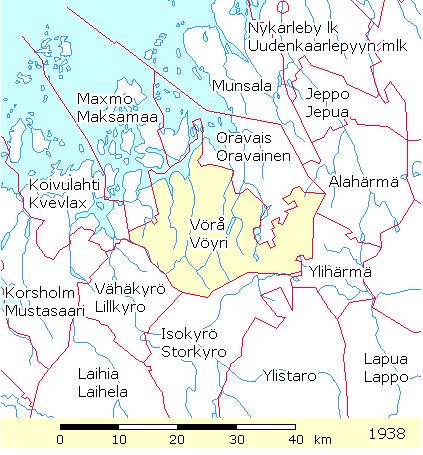
This map highlighting the Vörå parish from 1938 displays on the
HisKi project website. It is made available by the Genealogical
Society of Finland.
Parish History
- Prior to 1490, the Vora parish was divided between Pedersore, Storkyro and Korsholm.
- In 1490, Vöra became an independent parish
Parish Records
Because parish Communion records are listed by village and farm names and because farm names often were used as a part of a person’s name, it is interesting to note the following farms. The 1880 – 1890 parish Communion Records were used to identify the following villages.
Villages & Farms
The villages within the Vörå parish (listed in alphabetical order) include:
- Andiala
- Bergby
- Bertby
- Jörala
- Kaitsor
- Karvsor
- Koskeby
- Kovjoki
- Lomby
- Lotlaks
- Lålaks by
- Miemoisby
- Myrbersby
- Mäkipää
- Palvis
- Rekipeldo (Rejpelt)
- Rökiö
- Tuckur
To open a printable list of villages and farms in alphabetical order (pdf), click here.
Villages listed next are in the same order as they were listed in the Communion Book of 1880-1890; located from south to north. In parenthesis are possible older names of the villages and farms. 4
- Jåfs
- Smeds
- Svens (Storkarhu)
- Kastus
- Wäst
- Peth
- Grannas (Lilkarhu)
- Simons
- Omars
- Klemets
- Israels
- Fors (Joskarhu)
- Kullas (Korvolainen)
- Långs
- Bengs (Konung)
- Ehrs
- Bjons
- Pörnull
- Badstubacka
- Härtull
- Jåfs
- Bondas (Johans)
- Bertils
- Heinull
- Kattil
- Jakas (Jakobs)
- Nickull
- Träsk (Kaurajärfvi)
- Ruths
- Mannil
- Grannas
- Nyby
- Hirsal
- Härtus
- Antill
- Martois
- Budd
- Kylkis (Kylckinen)
- Thors
- Rasmus
- Ohlis
- Jäppil
- Knuts
- Skrivars
- Ingo
- Kulp
- Kaustinen
- Nissil
- Jussil
- Kjerp
- Kjötar
- Ollil
- Smeds
- Talus
- Konsti
- Jopers
- Dalkarl
- Gråbbil
- Isakas (Storkneck)
- Ollus (Kråka)
- Sippus
- Klemets
- Råndman
- Kamis (Kaminen)
- Nikus (Nikonen)
- Bengs
- Knubb
- Kneck (Lilkneck)
- Grannas
- Karlas (Karjalainen)
- Grims
- Miemois
- no farm listed with this number
- Nygård (Jufvas)
- Krooks
- Grind
- Murkais
- Grägg
- Seppäs (Seppä)
- Ohlis (Antohlis)
- Staffans (Ohlis)
- Wöråborg
- Lillund
- Storlund
- Gammals
- Smårus
- Pytar
- Holms
- Påhls
- Kullas
- Höijer
- Knuts
- Gammals
- Antbrams
- Nygård
- Bagg
- Rex
- Svens
- Brams
- Klärck (Clerck)
- Antus
- Jåfs
- Fors (Bredfors)
- Jåssis
- Måsa
- Ollus
- Haga
- Enges
- Dunck
- Norrgård (Helsing)
- Ehrs
- Jåfs
- Grind
- Brors
- Åkers
- Skott (Skått)
- Back
- Rex
- Finne
- Sväls
- Jånt
- Kock (Kåck)
- Bertils
- Månsus
- Widd
- Smeds
- Ingo
- Herr
- Hofman (Håfman)
- Hof (Håf)
- Simons (Kafvus)
- Antus
- Bobacka (Tåss)
- Skarper
- Södergård (Pärus)
- Kejsar
- Heikius
- Finne
- Hannus
- Bertils
- Sigfrids
- Håkus
- Präst
- Blusi
- Sandås (Norkinen)
- Lassus
- Backull
- Kullas
- Ohls
- Krooks
- Helsing
- Källbacka (Klafvus)
- Skata
- Huggars (Rännar)
- Rännar (Nytomt)
- Nytomt
- Slögs
- Åkers
- Snickars
- Skåtar
- Lassus
- Yrjas
- Knuts
- Ströms
- Ehrs
- Peth
- Kålax
- Finnas
- Ollus
- Toppar
- Zachris (Sakers)
- Lillkålax
- Pedar
- Strand
- Jåfs
- Thors
- Antus
- Mattus
- Trött
- Backils
- Gåll
- Svens
Parish Church
The first church was built around 1490, when Vörå became an independent parish.
The current church was built in the 1620s and completed in 1626. It is the oldest wooden church in Finland, still in use. The bell tower was built in 1702. 2,5
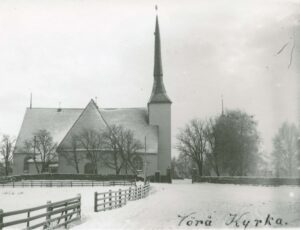
Vörå Kyrka, picture taken in winter of 1918. This file is
made available under Creative Commons 4.0.
Author: Erik Hägglund
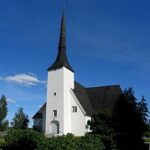
Vörå Church in 2012. This file is made available under the Creative Commons . the Creative Commons CC0 1.0 Universal Public Domain Dedication. Attribution: Jonund
Of interest
Growing & Harvesting Rye 4
There is no doubt that farming was very hard work for the entire family. Vörå is still farming country but of course, technology is vastly improved.
1. When one crop was harvested, it was time to prepare the soil for the next crop. Fields were plowed using horses.
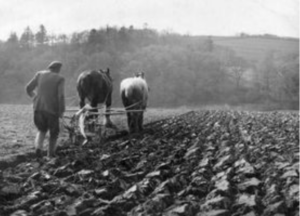
2. Working the land continued in winter. Dung was moved from barns and piled in the fields. These piles were spread as fertilizer.

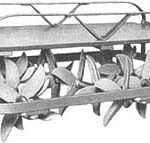
3. In the spring fields were plowed and then harrowed. Harrowing evened the plowed field before sowing. The second picture shows a harrowing machine used in the 1940s.

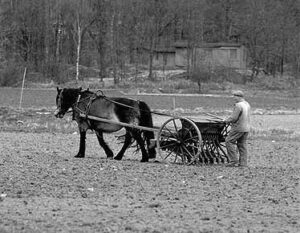
4. Seeds were sown by hand,
and later by machine.

5. When rye was ready to be harvested, hand sickles were
used to cut it.

6. Once cut, the rye was tied together into sheaves, and then
8 sheaves were stacked at right angles and another one on top
forming a hat. This was called a ‘ragskyl’.
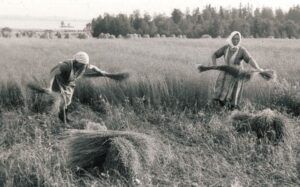
7. The ‘ragskyl‘ were left in the field for initial drying. Later the
sheaves were moved to barns called a ‘ria‘. The buildings
below are examples of ‘ria’. There was an oven in the ‘ria’ which
helped the drying process.

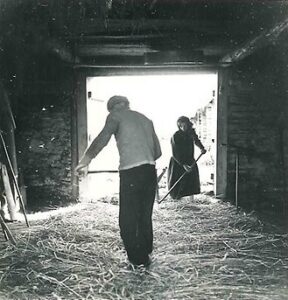
8. Dried sheaves were then placed on the barn floor and
thrashed by hand.
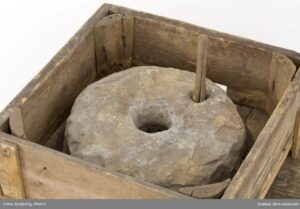
9. To utilize the grain, it was ground into flour using hand
grindstones (below) or those powered by windmills.
Folk Dress
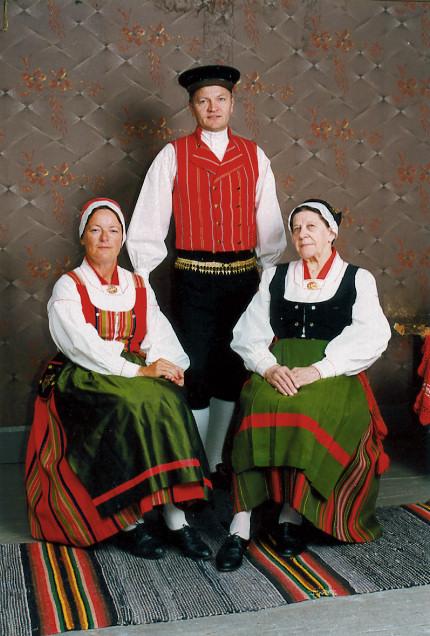
Each parish has a unique folk dress. Parish folk dress can be recognized by its style, colors, and patterns.
Vörå folk dress photo used with permission of the Brage costume agency.
References:
- Genealogical Society of Finland, HisKi project, Vörå parish, http://hiski.genealogia.fi/hiski/a6ue00?en+0643
- Jensen, Alicia, ‘Discovering Swedish Speaking Municipalities: Vörå’, Helsinki Times; December 18, 2014
- Karsten T.W., Svesk Bygd I Osterbotten: Nu Och Fordom; Helingfors, 1923, Vörå, pages 153 – 168
- Nikus, Torbjorn, farm pictures, village and farm names, member of Swedish Finn Historic Society
- Visit Vaasa Finland, visitvaasa.fi > Eat, See & Do > Culture > Historic Attractions: http://www.visitvaasa.fi/en/search/pages/sites.aspx?paikka=&pakti=1&a1akti=41 and Churches: http://www.visitvaasa.fi/en/search/pages/sites.aspx?paikka=&pakti=1&a1akti=53
- Vörå, https://en.wikipedia.org/wiki/V%C3%B6r%C3%A5
- Vörå, https://translate.google.com/translate?hl=en&sl=sv&u=https://sv.wikipedia.org/wiki/V%25C3%25B6r%25C3%25A5&prev=search
- Vörå Church images, https://www.finna.fi/Record/sls.%25C3%2596TA+135%252C+SLS+865_SLS+865+B+201 and https://commons.wikimedia.org/wiki/File:V%C3%B6r%C3%A5_kyrka.jpg
- Vörå Folk Dress image, Brage costume agency, https://www.brage.fi/sve/draktbyra/draktbyran/folkdrakter/view-163648-103
Initial research done by SFHS President Bill Carlson.