
Ostrobothnian
Kvevlax

Land
The parish of Kvevlax sets on the shore of the Gulf of Bothnia. The landscape is flat and is characterized primarily by the valley of the Kyrö River and its delta. The river flows into the Vassor Bay of the Gulf of Bothnia. 4
This map of the Kevlax parish in 1938 displays on the HisKi project website, made available by the Genealogical Society of Finland.
Parish History
- As a part of the Korsholm parish, Kvevlaxs became a chapel parish in 1692 4
- In 1857 it became an independent parish 4
Parish Records
Villages and farms of Kvevlax were recorded in T.W. Karsten’s work, Svesk Bygd I Osterbotten: Nu Och Fordom. 2 Kvevlax Parish Communion records were not used to confirm these findings.
Because parish Communion records are listed by village and farm name and because farm names often were used as a part of a person’s name, it is interesting to note the following farms.
To open a printable list of villages and farms (pdf), click here.
Villages & Farms
The historic villages in Kvevlax include:
- Koskö
- Kyrkobyn, the church village
- Petsmo
- Vassor
- Västenhankmo
- Östenhankmo
Historic farms
- Burman
- Frantz
- Nygård
- Jakkula
- Krus
- Herrgård
- Kvenlander
- Svarvar
- Hjort
- Hurr
- Nygård
- Norrgård
- Enrot
- Lustig
- Knip
- Al
- Svan
- Lunelund
- Back
- Fant
- Berts
- Möuts
- Håkans
- Lund
- Bejar
- Örn
- Rabb
- Vik
- Södergård
- Åman
- Kuni
- Östman
- Heir
- Vasberg
- Ivars
- Hinders
- Mälsor
- Sand
- Näsman
- Varg
- Holm
- Back
- Björk
- Ström
- Nygård
- Finne
- Skräddar
- Riko
Parish Church
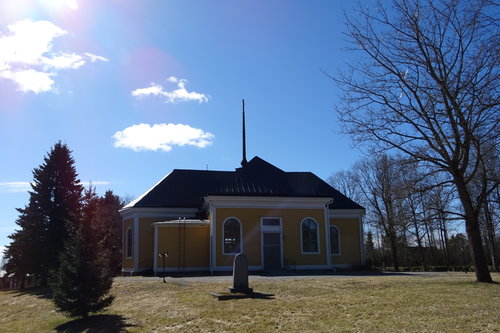
The peasant farmer, Hans Larsson Qweflander of Kvevlax, built the Kvevlax church between 1691 and 1693. It was an extended polygon church. The church dedication took place on December 4, 1692. 5, 9 The extended polygonal church design is a special art-type structure. The Kvevlax church is the oldest representative in Finland of this type. According to art historians, ‘the origin of the church type can be derived from the French and Dutch reformed and, to some extent, the deliberately radical church architecture [is] from the end of the 16th century and the early 17th century’. 9
In 1793, the Supreme Court planned an extension of the church. Chaplain Master Wihlem Granlund designed the extension. It was constructed during 1794 and 1795. The extension turned the church into the shape of a cross. 5
To view a video of the Kvevlax church, click here.
This picture was copied from https://www.kvevlaxforsamling.fi/kyrka-och-lokaler/kvevlax-kyrka
Of Interest
Stone farms
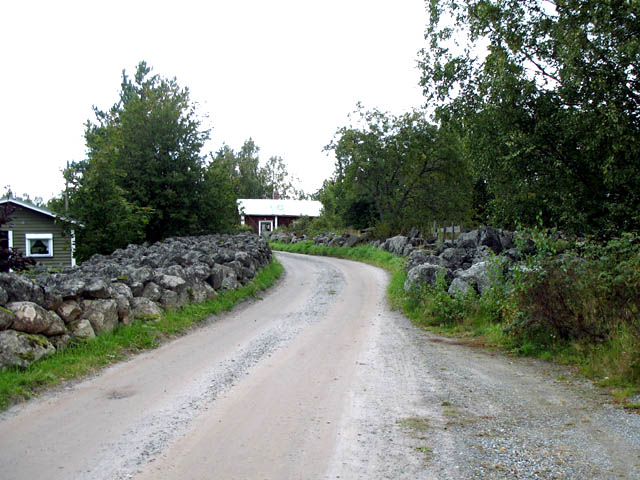
Prompted by a tax exemption in 1740 from the Swedish crown for cleared marshland, a large amount of land was cleared and cultivated in Kvevlax. With this, more arable land was created and farming became more efficient. This clearing was completed in 1765. After the land was cleared, stones were gathered from the fields and made into very wide and low fences. The stone fences define each farms’ courtyard and arable land. One example of these ‘stone farms’ is found along the road that leads to the Moippe village. 10
Photo: Stengärdesgårdarna i Moippe by, Korsholm. Moippevägens stengärdesgårdar i Korsholm. Bild: MV/RHO Maria Kurtén 200
Folk Dress
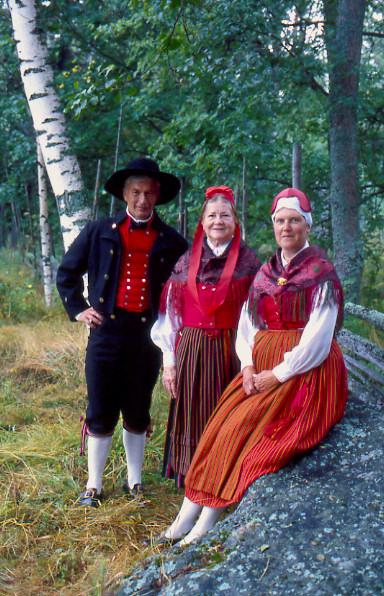
Each parish has a unique folk dress. Parish folk dress can be recognized by its style, colors and patterns.
Kevlaxs folk dress photo used with permission of the Brage costume agency.
References:
- Genealogical Society of Finland, HisKi project, Kvevlax parish, http://hiski.genealogia.fi/hiski/a48dcq?en+0216
- Karsten T.W., Svesk Bygd I Osterbotten: Nu Och Fordom; Helingfors, 1923, Kvevlax, pages 104 – 109
- Kvevlax, https://sv.wikipedia.org/wiki/Kvevlax
- Kvevlax, https://uppslagsverket.fi/sv/view-103684-kvevlax
- Kvevlax Church, https://www.discoveringfinland.com/destination/church-of-kvevlax/
- Kvevlax Church image, copied from https://www.kvevlaxforsamling.fi/kyrka-och-lokaler/kvevlax-kyrka
- Kvevlax Church video, https://youtu.be/3sJT6a7x8co
- Kvevlax Folk Dress image, Brage costume agency, https://www.brage.fi/sve/draktbyra/draktbyran/folkdrakter/view-163648-77
- Kvevlax Forsämling, Church history, https://www.kvevlaxforsamling.fi/kyrka-och-lokaler/kvevlax-kyrka/historia
- Stone Farms in Moippe Village, http://www.kulturmiljo.fi/read/asp/rsv_kohde_det.aspx?KOHDE_ID=2048 select ‘på Svenksa’ to get English translation
Initial research done by SFHS Board Member – Dale Hjort